
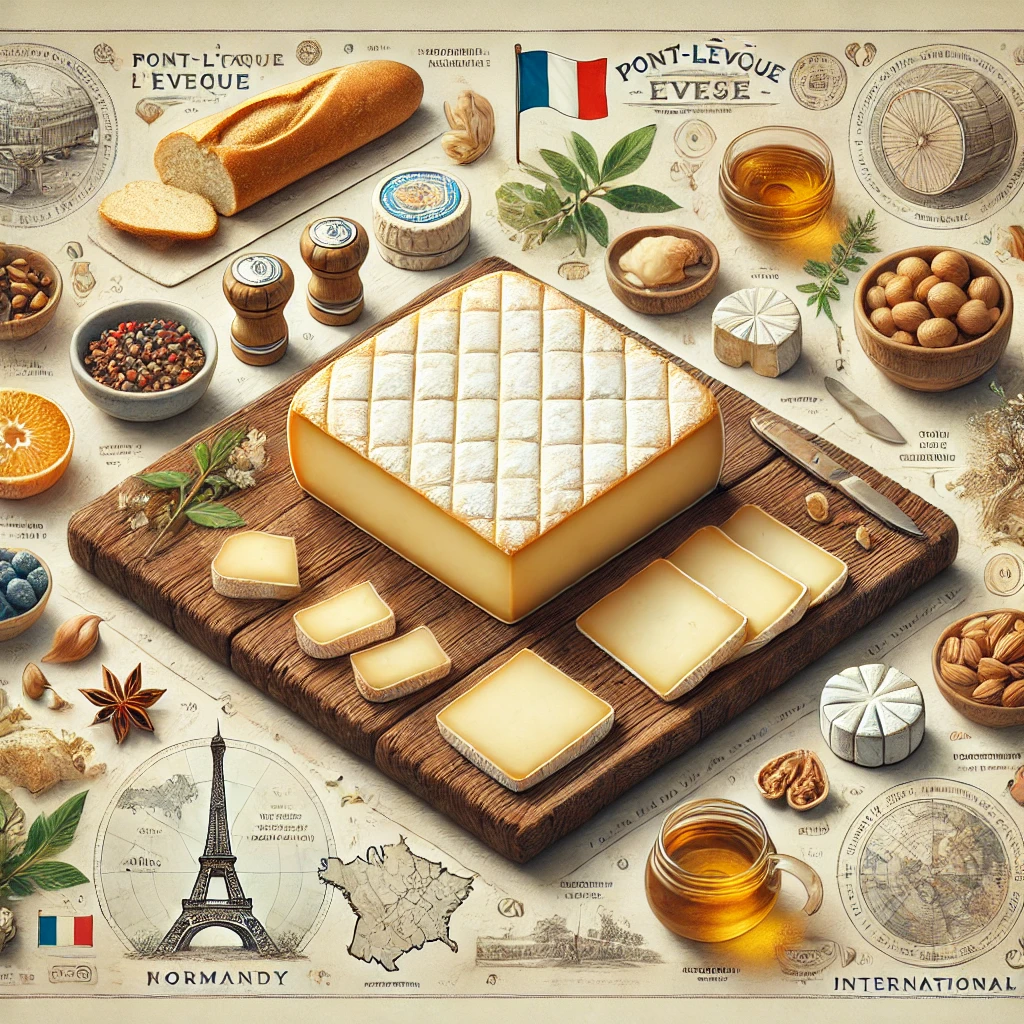
Among France’s most storied cheeses, Pont-l’Évêque holds a distinguished place. Soft, aromatic, buttery, and richly expressive of Normandy’s lush pastures, this square-shaped cheese dates back nearly a millennium. While Camembert often steals the spotlight, Pont-l’Évêque is arguably the more refined, more balanced, and more historically rooted of Normandy’s dairy treasures.
Named after the town of Pont-l’Évêque in Calvados, this washed-rind cheese is a PDO-protected product, meaning its identity is tightly linked to its terroir—cows grazing on Normandy’s wet green meadows, sea-salt air, temperate drizzle, and centuries-old monastic dairy craft.
🧀 What Is Pont-l’Évêque Cheese?
Pont-l’Évêque is a soft, washed-rind, cow’s milk cheese originating from Normandy. With its square form, golden crust, and creamy, pale interior, it offers aroma and depth without overwhelming sharpness.
Key Features
| Attribute | Description |
|---|---|
| Texture | soft, cream-dense, lightly elastic |
| Rind | washed, sticky, golden-tan, aromatic |
| Flavor | buttery, mushroomy, mildly salty, earthy |
| Aroma | floral pasture, barn-washed rind notes |
| Aging | 4–7 weeks |
| Milk | exclusively cow’s milk (PDO rule) |
Pont-l’Évêque is a cheese of balance—neither as pungent as Époisses nor as mild as Brie.
🇫🇷 History: From Monks to Global Markets
Pont-l’Évêque is one of France’s oldest known cheeses, first documented in the 12th century. Cistercian monks in Normandy developed it as a softer, more refined alternative to salt-heavy monastery cheeses.
Why It Endured Through Centuries
-
adaptable texture for bread and wine
-
excellent aging potential in damp sea-air climates
-
distinct square mold shape for easier packaging and trade
By the 17th century, Pont-l’Évêque became a major market cheese in northern France, with farmers standardizing size, salting, and washing techniques.
Today, it remains an export star—sitting proudly on cheese boards worldwide.
🥛 How Pont-l’Évêque Is Made
Production at a Glance
-
Raw or pasteurized cow’s milk is warmed.
-
Cultures and rennet are added for curd formation.
-
Curds are cut coarsely to preserve moisture.
-
Cheese is molded into square forms.
-
Repeated washing of the rind encourages orange bacteria (brevibacterium linens).
-
Cheese ripens for 4–7 weeks on wooden shelves.
What Washing Does
-
enhances aroma
-
softens rind
-
develops nutty, earthy, mushroom-cream notes
The rind is edible and crucial to the flavor core.
🌍 Pont-l’Évêque on the International Stage
With PDO protection since 1976, Pont-l’Évêque cannot be truly replicated outside Normandy, but global artisan versions exist, especially in:
-
Quebec (French dairy heritage)
-
Wisconsin (soft washed-rind experiments)
-
Switzerland (Normandy-influenced lines)
However, authentic Pont-l’Évêque must:
-
be made in Normandy
-
use Normandy cow’s milk
-
follow defined maturation rules
This ensures consistency: grassy creaminess, coastal microflora, and barn-washed aromatics.
🍽 Serving & Pairing Guide
How to Serve Pont-l’Évêque
-
remove from fridge 1 hour before serving
-
serve on cheese board at room temperature
-
do not overwrap—allow rind to breathe
Perfect Pairings
| Partner | Why It Works |
|---|---|
| Baguette or Pain de Campagne | neutral crust supports rich cream |
| Norman cider | acidity complements buttery core |
| Calvados | regional harmony + apple brandy contrast |
| Dry Riesling | fruit + acid balance washed rind aroma |
| Pears, apples, figs | sweetness lifts earthy tones |
Charcuterie Companions
-
cured ham
-
smoked duck
-
walnut pâté
-
cornichons
🌶 Flavor & Texture Breakdown
Flavor Notes
-
cultured butter
-
damp grass & mushroom
-
slight salt
-
cellar wood & rind tang
Texture Experience
-
creamy center softens outward
-
rind remains elastic
-
melt-in-mouth dairy depth without ammonia bite when well aged
Pont-l’Évêque is aromatic, not aggressive—making it friendly to cheese newcomers and rewarding for connoisseurs.
🍷 Beverage Pairing Suggestions
| Drink | Why It Works |
|---|---|
| Norman cider (dry) | apple acidity meets rind depth |
| Chenin Blanc | honey-pear notes + minerality |
| Champagne brut | bubbles clean palate richness |
| Red Burgundy (light) | cherry + earth mirror cheese terroir |
| Wheat beer | yeast + malt complement washed rind |
Avoid high-tannin reds—they can clash with washed-rind aromatics.
🌱 Nutrition Profile
Per 100g (approx.):
| Nutrient | Value |
|---|---|
| Calories | moderate-high |
| Protein | strong dairy source |
| Fat | high (buttercream feel) |
| Calcium | excellent |
| Sodium | moderate |
Naturally, rind bacteria may offer microflora benefits when cheese is properly stored and ripened.
🧊 Storage Instructions
Best Practices
-
wrap in wax or cheese paper, not plastic
-
refrigerate at 7–10°C
-
allow airflow around rind
If smelled too strongly of ammonia, it has over-ripened.
⭐ Final Summary
Pont-l’Évêque is not just a cheese—it is Normandy geography condensed:
-
lush dairy pastures
-
Atlantic humidity
-
monastic precision
-
barn-washed culture development
Its square shape signals tradition; its flavor signals centuries of refinement. From bistro platters to Michelin-star boards, Pont-l’Évêque remains one of the world’s most elegant yet approachable washed-rind cheeses.
Creamy but structured, aromatic but never vulgar—Pont-l’Évêque is France’s quiet masterpiece.
FAQs — Pont-l’Évêque Cheese
1. What kind of cheese is Pont-l’Évêque?
A soft, washed-rind cow’s milk cheese from Normandy, PDO-protected.
2. Does Pont-l’Évêque have a strong smell?
It is aromatic but less intense than Époisses or Munster.
3. Can you eat the rind?
Yes—the rind is edible and essential to flavor character.
4. How long is it aged?
Typically 4–7 weeks for ideal aroma and texture balance.
5. How should it be served?
Room temperature with crusty bread, cider, fruit, and nuts.