
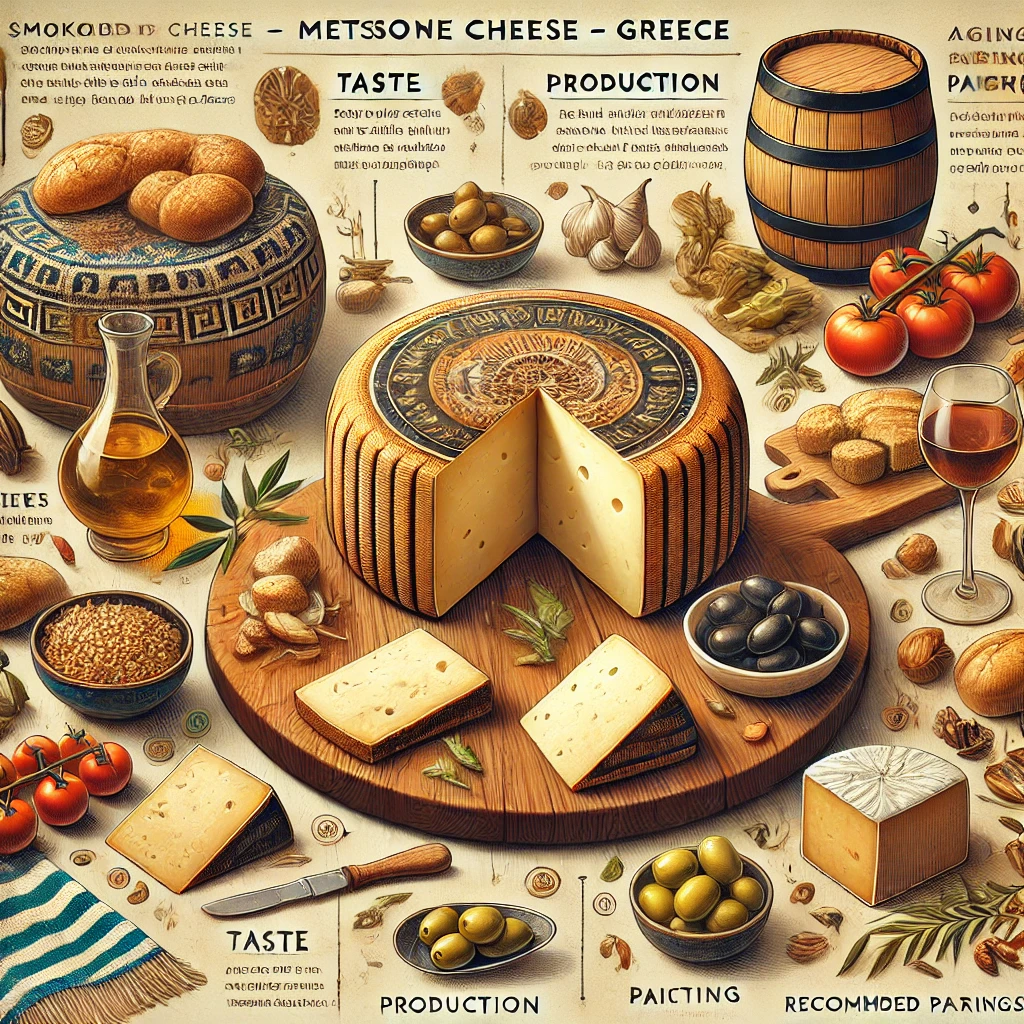
Amid the stone villages and mountain plateaus of Epirus in northern Greece, one cheese stands as a hallmark of regional tradition and monastic craftsmanship: Metsovone. Produced in Metsovo, a historic town known for Vlach heritage, pastoral grazing, and smoked dairy culture, Metsovone is more than a cheese—it is a Protected Geographical Indication (PGI) product that encapsulates the taste of alpine meadows and centuries-old Greek cheesemaking knowledge.
Metsovone is firm, smoky, buttery, and elegant. It occupies a unique place in the world of European smoked cheese, standing proudly beside Italy’s scamorza affumicata and Germany’s Rauchkäse, yet retaining a distinctly Greek flavor identity and terroir-driven aroma.
🧀 What Is Metsovone?
Metsovone is a semi-hard to hard smoked cheese produced using a technique that combines Italian pasta filata pulling with traditional Greek aging.
Key Characteristics
| Attribute | Description |
|---|---|
| Category | Semi-hard, smoked cheese |
| Milk | Cow’s milk, or blend of cow, goat & sheep |
| Texture | firm, elastic, sliceable |
| Flavor | smoky, buttery, slightly tangy |
| Aging Time | 3–6 months |
| PGI Status | Protected under EU law |
Its balanced texture means it can be sliced for platters, grated over pasta, grilled, or melted.
🌄 Origins: A Mountain Village with Dairy Legacy
Metsovo lies in Epirus, near Pindus mountain ranges. Historically a Vlach (Aromanian) settlement, it has long relied on:
-
roaming sheep
-
high-altitude cattle
-
woodland grazing
-
seasonal transhumance
Cheese production here is shaped by:
-
alpine herbs (thyme, oregano, sage)
-
mountain hay
-
clean spring water
-
cold smoke curing rooms
This environment gives Metsovone its floral-mineral undertones beneath the smoke.
🧀 Production Process
Metsovone is not just smoked at the end—it undergoes a painstaking stretched-curd method similar to provolone or caciocavallo.
Steps
-
Milk Collection
-
Fresh cow or mixed milk sourced directly from mountain herds.
-
-
Curdling
-
Rennet forms curds.
-
-
Curd Stretching (Pasta Filata Technique)
-
Curds are heated in whey and stretched into elastic consistency.
-
-
Shaping & Salting
-
Traditional cylindrical rolls tied in pairs with rope.
-
-
Aging
-
3–6 months in cool stone cellars.
-
-
Smoking
-
Natural wood smoke gently permeates cheese surface.
-
Why Smoke?
-
preservation before refrigeration era
-
added complexity
-
trademark aroma
Unlike industrial smoking, Metsovone is naturally smoked over regional hardwood, giving a clean, golden hue.
🧂 Taste & Texture Profile
Metsovone is refined rather than overpowering.
Flavor Notes
-
delicate smoke
-
nutty finish
-
subtle sweetness
-
buttery fat mouthfeel
-
faint lactic tang
Texture Notes
-
springy yet dense
-
smooth slicing
-
ideal melting without oil separation
Unlike sharp aged feta or salty graviera, Metsovone offers gentle sophistication.
🍽 Culinary Uses & Best Serving Ideas
Metsovone adapts easily to both rustic and modern Mediterranean cuisine.
Traditional Serving
-
sliced with olives & tomatoes
-
grilled over village bread (fourno psomi)
-
pan-fried with lemon squeeze
Modern Applications
| Dish | Use |
|---|---|
| Pizza | replaces mozzarella for smoky finish |
| Pasta bake | grated topping, melts evenly |
| charcuterie board | smoky centerpiece |
| grilled cheese sandwich | richer than cheddar |
| creamy risotto | stirred at finish |
🥂 Perfect Pairings
Wine Pairings
| Wine | Why It Works |
|---|---|
| Xinomavro | acidity cuts smoke & butter |
| Assyrtiko | crisp citrus contrast |
| Robola | gentle mineral pairing |
| Malagouzia | floral notes complement wood smoke |
Beer & Spirits
-
pale ale
-
Greek tsipouro (traditional distillate)
-
craft pilsner
Food Pairings
| Food | Reason |
|---|---|
| roasted figs | sweet vs smoke contrast |
| cured meats | fuller palate |
| walnuts & honey | Greek countryside harmony |
| sun-dried tomatoes | tang meets richness |
🧊 Storage & Handling
Because Metsovone is semi-hard and smoked, it keeps longer than fresh cheese.
Storage Tips
-
refrigerate tightly wrapped
-
avoid plastic contact on cut surfaces (waxed paper + container preferred)
-
do not freeze (alters elasticity)
Shelf Life
| Condition | Duration |
|---|---|
| sealed | 4–6 months |
| opened | 3–4 weeks |
| sliced | 1–2 weeks |
Let it rest at room temperature before serving for peak aroma.
🌍 Comparison with Other Smoked Cheeses
| Cheese | Region | Similarity | Difference |
|---|---|---|---|
| Scamorza affumicata | Italy | smoked & stretched | Metsovone more buttery |
| Provolone | Italy | stretched-curd | Metsovone lighter smoke |
| Kasseri | Greece | semi-hard | no smoking |
| Graviera | Greece | nutty | firmer & sharper |
Metsovone sits between Italian pulled-curd heritage and Greek alpine dairy identity.
⭐ Conclusion
Metsovone is Greece’s smoky crown jewel—a cheese that honors village craft, alpine milk, and the subtle art of smoking.
With its PGI protection, balanced nut-smoke profile, and smooth melting ability, it deserves a place on:
-
gourmet cheeseboards
-
modern Mediterranean plates
-
rustic mountain feasts
-
wine pairings under an olive-lit sunset
Whether grilled, sliced, melted, or eaten plain, Metsovone captures the taste of Greece’s highlands—smoke, pasture, and tradition in harmony.
FAQs – Metsovone Cheese
1. Is Metsovone naturally smoked?
Yes. It is smoked with regional wood, not flavored chemically.
2. What milk is used?
Cow milk, sometimes blended with sheep or goat.
3. Can it melt?
Beautifully—it melts smoothly without oil separation.
4. How long is it aged?
Typically 3–6 months before smoking.
5. How is Metsovone served?
Grilled, sliced, on charcuterie boards, or melted onto pasta and bread.