
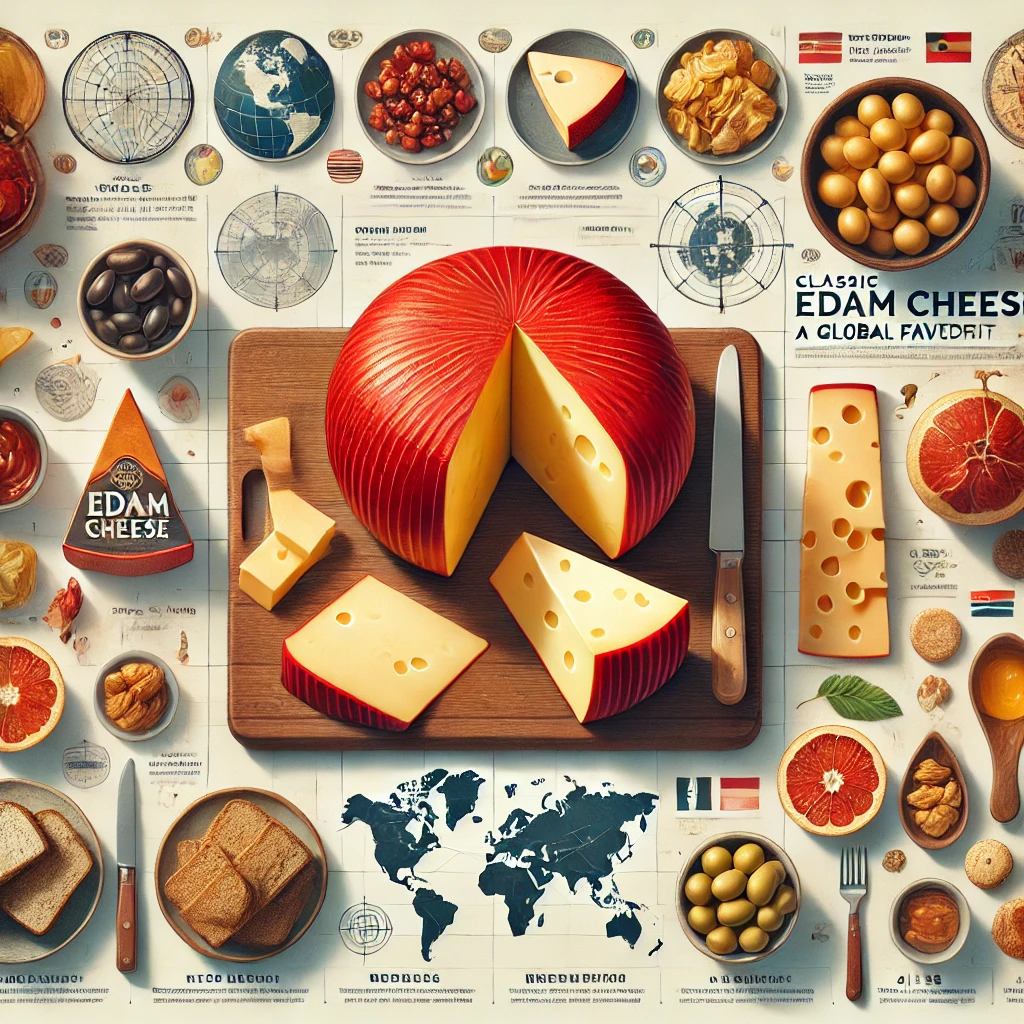
Few cheeses have traveled the world as successfully as Edam cheese. Instantly recognizable by its smooth texture, mild flavor, and iconic red wax coating, Edam has become a household name far beyond its Dutch homeland. From European breakfast tables to sandwiches in Asia and cheese boards in the Americas, Edam’s universal appeal lies in its balance: gentle taste, versatility, and remarkable shelf stability.
This comprehensive guide explores Edam cheese’s origins, production methods, taste profile, varieties, culinary uses, global popularity, pairings, storage, and nutritional value—explaining why Edam remains one of the most widely loved cheeses on Earth.
🧀 What Is Edam Cheese?
Edam is a semi-hard cow’s milk cheese that originated in the Netherlands. Traditionally shaped into spheres and coated in red wax, Edam is known for its mild, slightly nutty flavor and firm yet supple texture.
Key Characteristics
| Feature | Description |
|---|---|
| Cheese type | Semi-hard |
| Milk | Cow’s milk |
| Texture | Firm, smooth, elastic |
| Flavor | Mild, nutty, slightly salty |
| Color | Pale yellow |
| Aging | 1–12 months |
| Rind | Wax-coated (traditionally red) |
Unlike stronger cheeses, Edam is designed to be approachable, making it suitable for all ages and cuisines.
🌍 Origins of Edam Cheese
Birthplace: The Netherlands
Edam cheese originates from the town of Edam, located in North Holland. As early as the 14th century, the town was an important trading hub, with easy access to waterways that connected Dutch dairy producers to international markets.
A Cheese Built for Travel
Edam’s global success was no accident. Its creators intentionally developed a cheese that:
-
contained less fat than many contemporaries
-
resisted spoilage
-
aged well without cracking
-
tolerated long sea voyages
Because of this durability, Edam became a staple aboard ships and a valuable export during the Dutch Golden Age.
🌎 How Edam Became a Global Favorite
Maritime Trade & Colonial Routes
Dutch traders exported Edam throughout:
-
Europe
-
Southeast Asia
-
the Caribbean
-
Africa
-
the Americas
In many regions, Edam became one of the first European cheeses people encountered.
Adaptation Across Cultures
Edam’s mildness allowed it to integrate easily into:
-
local cooking styles
-
sandwiches and snacks
-
hot and cold dishes
Today, Edam is produced not only in the Netherlands but also in countries such as:
-
Germany
-
France
-
Poland
-
Spain
-
South America
-
parts of Asia
While authentic Dutch Edam remains protected, Edam-style cheeses are truly global.
🥛 How Edam Cheese Is Made
Traditional Edam production balances precision and simplicity.
1. Milk Preparation
Pasteurized cow’s milk is gently heated and inoculated with starter cultures.
2. Coagulation
Rennet is added, causing the milk to form curds.
3. Cutting the Curds
The curds are cut into small pieces to release whey and control moisture.
4. Washing the Curds
Part of the whey is replaced with warm water.
This washed-curd process:
-
reduces acidity
-
creates Edam’s mild sweetness
5. Molding & Pressing
Curds are pressed into round molds, forming smooth balls.
6. Brining
Cheeses are soaked in salt brine to enhance flavor and preservation.
7. Waxing & Aging
After drying, Edam is coated in wax and aged for weeks or months.
🧂 Taste & Texture Profile
Edam’s charm lies in its restraint.
Flavor Notes
-
mild and milky
-
subtle nuttiness
-
lightly salty
-
slightly sweet finish
As Edam ages, it develops:
-
deeper nutty tones
-
a firmer body
-
gentle savory complexity
Texture
-
smooth and elastic
-
easy to slice
-
slightly crumbly when aged
-
never greasy
This balance makes Edam suitable for both eating plain and cooking.
🧀 Varieties of Edam Cheese
Young Edam (4–6 weeks)
-
soft and elastic
-
very mild
-
ideal for sandwiches
Mature Edam (3–6 months)
-
firmer texture
-
more nutty flavor
-
versatile in cooking
Aged Edam (10–12 months)
-
pronounced flavor
-
slightly crumbly
-
hints of caramel and umami
Reduced-Fat Edam
-
lighter option
-
popular in health-conscious markets
-
still retains Edam’s signature taste
🍽️ Culinary Uses of Edam Cheese
Edam’s adaptability is one reason for its worldwide popularity.
1. Everyday Eating
-
sliced for sandwiches
-
cubed for snacks
-
paired with bread and fruit
2. Cooking & Baking
Edam melts evenly without separating, making it ideal for:
-
casseroles
-
omelets
-
quiches
-
baked pasta
-
cheese sauces
3. International Dishes
Used globally in:
-
European breakfast plates
-
Asian bakery breads
-
Latin American snacks
-
fusion cuisine
4. Cheese Boards
Edam’s mildness balances stronger cheeses, appealing to a wide audience.
🥂 Best Pairings for Edam Cheese
Food Pairings
| Pairing | Why It Works |
|---|---|
| Apples & pears | Enhance sweetness |
| Grapes | Refreshing contrast |
| Nuts | Complement nuttiness |
| Crackers | Neutral base |
| Mild cured meats | Balanced richness |
Beverage Pairings
-
light lagers
-
pilsners
-
dry white wines (Chardonnay, Sauvignon Blanc)
-
cider
-
sparkling water
Edam pairs best with clean, refreshing drinks.
🧊 Storage & Shelf Life
Storage Tips
-
wrap in wax or parchment paper
-
store in refrigerator
-
avoid plastic wrap directly on the cheese
-
keep away from strong odors
Shelf Life
| Type | Duration |
|---|---|
| Young Edam | 2–3 weeks |
| Mature Edam | 3–4 weeks |
| Aged Edam | 1–2 months |
Bring Edam to room temperature before serving for best flavor.
🌍 Edam vs. Similar Cheeses
| Cheese | Difference |
|---|---|
| Gouda | Richer, creamier, sweeter |
| Emmental | Larger holes, sharper |
| Maasdam | Sweeter, more elastic |
| Cheddar | Sharper, crumbly |
| Jarlsberg | Nutty with large eyes |
Edam remains milder and more universally approachable.
🌱 Nutritional Value
Edam is valued for balanced nutrition.
Benefits
-
good protein source
-
rich in calcium
-
moderate fat content
-
lower fat than many semi-hard cheeses
This balance makes Edam suitable for daily consumption.
🌍 Edam Cheese in the Modern World
Today, Edam continues to thrive because it:
-
appeals to diverse palates
-
adapts to many cuisines
-
stores and transports well
-
fits modern cooking styles
From supermarkets to fine dining, Edam remains a reliable, well-loved cheese.
⭐ Conclusion
Edam cheese has earned its reputation as a global favorite through centuries of consistency, adaptability, and thoughtful design. Mild yet flavorful, durable yet refined, Edam bridges cultures and cuisines with ease. Whether enjoyed fresh, melted into dishes, or served on a simple cheese board, it offers a taste that is comforting, familiar, and timeless.
For anyone exploring cheeses of the world, Edam is not just a classic—it is a cornerstone of global cheesemaking history.
FAQs – Edam Cheese
1. Where does Edam cheese come from?
Edam originates from the Netherlands, specifically the town of Edam.
2. Is Edam cheese mild or strong?
Edam is mild and slightly nutty, becoming stronger with age.
3. Does Edam cheese melt well?
Yes, it melts smoothly and evenly, making it great for cooking.
4. Why is Edam coated in red wax?
The wax protects the cheese during aging and transport.
5. Is Edam cheese healthy?
In moderation, yes—it provides protein and calcium with moderate fat.