Czechia’s dairy tradition is full of creamy spreads and soft curds, yet one cheese stands apart—not for mildness, but for its bold aroma and unmistakably sharp personality: Olomoucké tvarůžky (also known as Olmützer Quargel). Produced in Loštice, Moravia, this legendary golden cheese is Europe’s only matured, fat-free, naturally ripened curd cheese, and one of the oldest cheeses continuously made in Central Europe.
Its pungent profile might intimidate newcomers, but for Czech households, beer taverns, and Moravian food markets, Olomoucké tvarůžky is a culinary badge of identity—a cheese that proudly refuses to be gentle.
🧀 What Is Olomoucké Tvarůžky?
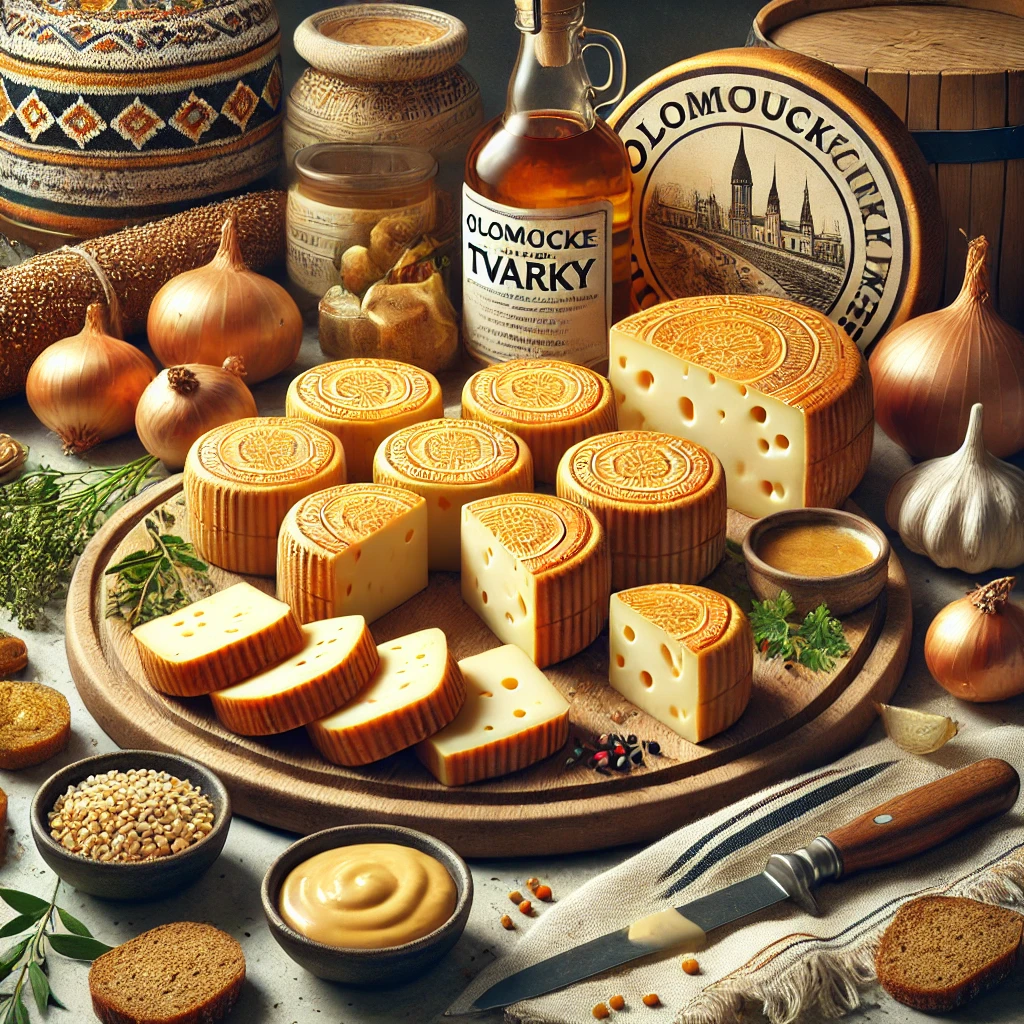
Olomoucké tvarůžky is a ripened curd cheese with a striking yellow surface and strong aroma.
Key Characteristics
| Feature | Description |
|---|---|
| Texture | Semi-soft, elastic, slightly shiny |
| Flavour | Sharp, fermented, savoury, salty-tangy |
| Aroma | Pungent, earthy, highly distinctive |
| Fat Content | Very low (naturally lean) |
| Colour | Yellow exterior, light interior |
| Origin | Loštice, Moravia, Czechia |
Despite its intensity, tvarůžky is surprisingly light, making it popular among those who want flavour without heaviness.
🇨🇿 Historic Roots: From Monks to Moravian Markets
The cheese dates back as far as the 15th century, originally made by monastic communities before becoming a regional trade product during the Austro-Hungarian era.
Cultural Timeline
-
1400s – Early fermentation techniques documented in Moravia
-
1600s–1800s – Sold in Olomouc markets, gaining its name
-
1800s onward – Production centralized in Loštice
-
21st century – Granted EU Protected Geographical Indication (PGI) status
This PGI protection ensures that only cheese made in Loštice can legally carry the name Olomoucké tvarůžky.
🥛 How Olomoucké Tvarůžky Is Made
Unlike creamy Central European cheeses, tvarůžky is created from skimmed curd, not whole milk.
Production Steps
-
Skimmed Milk Fermentation
Curd forms naturally, leaving minimal fat. -
Curd Pressing & Shaping
Shaped into:-
rings
-
small wheels
-
patties
-
-
Surface Maturation
No artificial coloring, no preservatives.
The golden hue forms purely from bacteria and ripening. -
Drying & Aging
Cheese rests in airy chambers to cultivate its signature aroma.
This results in a powerfully flavoured, nutritionally lean cheese—rare in European dairy tradition.
🍽️ How It’s Eaten in Czechia
Olomoucké tvarůžky appears everywhere from Prague beer halls to Moravian kitchens.
Traditional Serving Methods
-
with rye bread and onions
-
alongside pilsner beer
-
whipped into spreads with butter
-
thinly sliced over potatoes
Tavern Style
Served with:
-
mustard
-
pickles
-
black bread
-
cold lager
Modern Culinary Uses
-
gourmet sliders
-
tvarůžky-stuffed dumplings
-
flatbread melts
-
bold cheese boards
Its pungency works best when paired with acidity, carbonation, or dense bread.
🍺 Beer & Wine Pairings
No cheese pairs with Czech beer as effortlessly as tvarůžky.
Best Pairings
| Beverage | Why it Works |
|---|---|
| Czech Pilsner | crisp, bitter finish cuts cheese aroma |
| Lager | carbonation lifts tang |
| Wheat Beer | softens sharp edges |
| Dry Riesling | acidity balances funk |
| Grüner Veltliner | grassy notes complement fermentation |
For full Moravian authenticity: serve with rye bread, onion rings, and pickles.
🌍 How It Compares to Other Strong Cheeses
| Cheese | Similarity | Difference |
|---|---|---|
| Limburger | strong aroma | tvarůžky is fat-free & firmer |
| Taleggio | washed rind | tvarůžky is not creamy or rind-washed |
| Munster | pungent profile | tvarůžky is drier and tangier |
| Blue cheese | bold taste | tvarůžky lacks mold veins, cleaner bite |
Olomoucké tvarůžky stands uniquely in Europe as a low-fat cheese with maximal flavor punch.
🌱 Nutritional Profile
Per 100g:
| Nutrient | Amount |
|---|---|
| Calories | ~120 |
| Fat | 0–1% |
| Protein | 20–25g |
| Sodium | moderate |
| Carbs | low |
Why It’s Special
-
high protein, low fat
-
no artificial additives
-
probiotic fermentation
-
lactose-friendly for some eaters
🧀 Aroma: Why Is It So Strong?
The pungency isn’t accidental—it’s microbial artistry.
-
Ripening bacteria create ammonia-like aromatics
-
Humidity and airflow encourage surface reactions
-
No rind means aroma isn’t sealed, it circulates freely
It is bold but not spoiled—just intensely alive in sensory identity.
⭐ Final Thoughts
Olomoucké tvarůžky is not a cheese for the timid, nor does it try to be. It is a proud icon:
-
rustic Moravian trade product
-
uncompromisingly aromatic
-
nutritionally lean yet flavour-packed
-
protected as Czech heritage
In a world chasing mild, Instagram-friendly soft cheeses, tvarůžky remains purely itself—sharp, honest, historical, and deeply local.
FAQs — Olomoucké Tvarůžky
1. Why is Olomoucké tvarůžky so strong?
Its natural surface ripening and bacteria create deep fermented aroma without preservatives.
2. Is it really fat-free?
Yes, it is one of few European cheeses naturally made from skimmed curd.
3. How is it traditionally served?
With rye bread, onion, mustard, pickles, and Czech beer.
4. Does it melt?
It softens when heated but does not melt like gouda or brie.
5. Is it the same as Limburger?
No, Limburger is creamy and rind-washed; tvarůžky is firmer and naturally ripened.